
Dressing as a Canvas with Marimekko
By Alma Reyes
“There is only one responsibility—beauty.
There is only one reality—dream.
There is only one strength—love.”
—Armi Ratia, Marimekko founder
Marimekko (“Mari’s dress”), one of Finland’s leading apparel and interior houses, has nurtured a long-standing relationship with Japan since the 1960s. Katsuji Wakisaka became the brand’s first Japanese designer in 1968, showcasing playful, iconic prints like the “Bo Boo” pattern. Fujiwo Ishimoto followed in 1974, building thirty-two collaborative years of over 400 motifs that flawlessly united Japanese minimalism with Nordic sensibility. With the first Marimekko concept store established in Japan in 2006, the designer label has since become a household name among Japanese consumers.

The Tokyo Metropolitan Teien Art Museum proudly presents “Marimekko: Art of Printmaking—Beauty, Dream, Love,” a full retrospective of the innovative aesthetics and groundbreaking philosophy of Marimekko. Running until December 20 this year, the exhibition marks the trademark’s 75th anniversary and covers more than sixty pieces, spanning fashion, interior design, tableware, and accessories from the 1960s to the present. It offers a behind-the-scenes look into Marimekko’s printmaking process, featuring a comprehensive presentation of historical materials, paper cutouts, and original artworks of its key visuals. With the museum itself reflecting the French Art Deco style of the 1930s, the venue ideally captures the brand’s “power of patterns” and reverberating colors in an ageless ambiance.
The showcase’s introduction on the ground floor of the main building narrates Marimekko’s colorful history since its birth in 1951. Founder Armi Ratia hired young artists to develop imaginative designs on fabric at her husband’s oilcloth printing factory. That same year, Marimekko successfully launched its first fashion show, highlighting Ratia’s philosophy of the “dress as a canvas,” which embodied timeless, bold color contrasts and invigorating patterns designed to instill a positive spirit into everyday life. She enhanced the essence of Beauty in a functional manner, allowing a woman to run, dance, and work in a dress. The label proved promising across the foreign market, particularly after U.S. First Lady Jacqueline Kennedy purchased several dresses. Marimekko’s design principle has consistently permeated homes with its dramatic, saturated colors and a hands-on mindset. To date, the company has released over 3,500 distinct prints through collaborations with its designers. Some of these—focusing on natural landscape, abstract patterns, and flowers—parade through the gallery rooms on the first floor, syncing beautifully with the classic furnishings.
On the second floor, wardrobes echo black and white grids, stripes, nature-inspired motifs, repeating patterns, architectural and ornamental designs, and pieces culminating in a precious teamwork with Japanese and international creators. This includes a special installation produced by designer Akira Minagawa of the leading fashion and textile design brand, minä perhonen. The room presents a unique approach to tying textile loops into chains as a symbol of Marimekko’s consistent design ideologies and core values. Minagawa reinterprets Marimekko’s DNA through his own artistic eye of imbuing it with a Japanese perception. Having been an avid follower of Nordic craft and culture since his teenage years, Minagawa infuses Finnish sensibilities into his work and continues to partner with established Finnish design companies like Artek and Iittala. Ratia’s vision of Love dives into this creative synergy, associating with visionaries to achieve something meaningful together regardless of differences in cultures and perspectives.

Perhaps Marimekko’s most world-famous motif is “Unikko” (1964) designed by Maija Isola, who created over 500 prints for the company. As a painter and a textile designer, Isola believed in "free art" and often applied a hands-on process—painting on the floor using brushwork and cut paper to construct the original templates before transferring them onto large silk screens for hand-printing. The oversized, stylized red flower initiated the label’s signature look of exuberant petals on a high-impact scale, bursting with vibrant energy. The design has evolved into hundreds of diverse color combinations, ranging from black-and-white to pastels and primary shades. In 2024, Marimekko, in collaboration with Isola’s estate, also diversified the motif into “Iso Unikko,” which enlarges the petals’ proportions, sometimes featuring only one or two giant blooms extended over an entire piece of fabric. In the 1990s, Isola’s daughter, Kristina, devised a variation, the “Pieni Unikko,” which trims the flower size for smaller products.

Another pattern conceptualized by Isola in 1964, the “Seireeni,” deviates from the floral look, revealing graphic, continuous waves that suggest a hypnotic movement of flowing water. Its exaggerated dimensions were intended for decorating large spaces. Isola traveled extensively around Greece in the 1960s and was immensely captivated by the gentle ripples of the Aegean Sea. The scenery inspired her to design an image of mythical sirens. Today, the pattern appears on dresses, wool rugs, curtains, tablecloths, pillowcases, upholstery, wallpaper, and the top of Alvar Aalto’s “Bench 153B.”

Annika Rimala served as chief fashion designer at Marimekko from 1960 to 1982. Her portfolio beams with visual fluidity and organic geometry. One of her emblematic patterns from 1965, “Iso Laine” (“Large Wave”), expresses sweeping lines in mid-century minimalist tones. This motif adorned the hallmark Nappimekko dress (button dress), which rose to popularity during the late 1960s and early 1970s. Its relaxed, loose-fitting silhouette has become a symbol of liberation for progressive women.

A more recent design, the “Siirtolapuutarha” (2009)—meaning “city garden”—blends various botanical motifs such as robust flowers, dense foliage, and pictorial vegetables, in a vivacious community garden setting. Renowned printmaker Maija Louekari envisioned the nostalgia of a countryside surrounding a city’s ecosystem. The flat, floral rendering in blue and green hues meshes beautifully with black lined strokes of the produce. The design is seen on the “Oiva” ceramic tableware series by Sami Ruotsalainen, as well as on home linens, tote bags, and other lifestyle items.
In Annex Gallery 1, devoted to the printmaking process, the Japanese artist collective plaplax directed a stimulating video installation titled, “Factory as a Playground.” Centered on six themes—Architectural, Botanical, Storytelling, Landscape, Floral, and Ornamental— the immersive presentation brings the “Printing Mill” facility at Marimekko’s Helsinki headquarters directly into the museum. It recreates the stimulating process of screen printing: pressing color-specific screens onto immaculate white fabric and rolling a cylindrical bar across them to layer luminous shapes on top of each other. Visitors watch the moving designs on the screens come to life vigorously as the dynamic space combines excellent craftsmanship with cinematic expression. Here, Ratia’s concept of a Dream demonstrates Marimekko’s “ability and desire to see beyond the tangible world,” realizing possibilities that were once unimaginable.
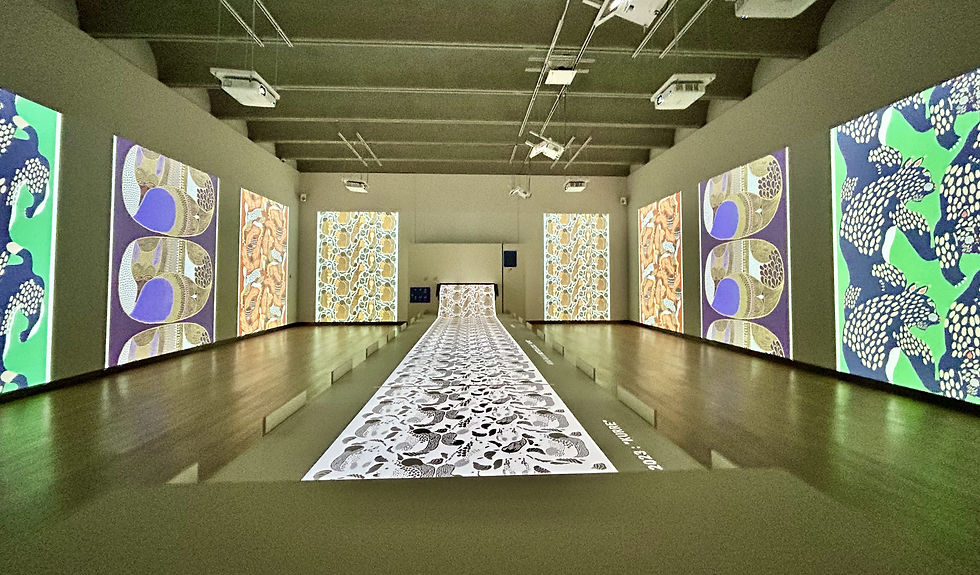
Marimekko’s solid tradition truly forges high-quality products, refined not only by a single voice, but by many, in a continuous dialogue that endures for generations.
Details
“Marimekko: Art of Printmaking—Beauty, Dream, Love”
Tokyo Metropolitan Teien Art Museum
Until December 20, 2026
Closed Mondays (except November 23), November 24
10:00-18:00 (November 6, 13, 20, 21, 27, 28, December 4, 5 open until 20:00)
Written by Alma Reyes


