Two Ways of Looking at Greece: The Hellenic Centre during Frieze Week
For most of Frieze week, London's attention sits in Regent's Park and around Mayfair. A short walk from all that, The Hellenic Centre is showing two exhibitions that complement each other well. One looks at Greece from the inside, through a painter who lived through the dictatorship. The other looks from the outside, through artists who have imagined the country from afar.

A Different Kind of Pop: Giorgos Ioannou’s Works 1960s–1970s
8 October – 19 November 2026

The centenary of Giorgos Ioannou’s birth (1926–2017) is the occasion for A Different Kind of Pop, the first substantial solo show of his work in London. He was prolific in Greece, but he is barely known in the UK, which makes this a real introduction. More than thirty paintings come from public and private collections, most made between the late 1960s and early 1970s, when Greece was under military rule.
Ioannou borrowed from Pop and comic-book imagery, and it’s easy to file him as a Greek Pop artist. The title points the other way. His work developed alongside American Pop, not from it, and the paintings carry personal memory, folk tradition, nostalgia and political trauma. The directness of the imagery let him speak plainly about the climate around him, even under censorship. He kept exhibiting through the junta years, including at the Greek Pavilion at the 1971 Venice Biennale, while opposing the regime. Director Nayia Yiakoumaki says his concerns with dignity, civil rights and peace “resonate with renewed urgency” today, and the work does feel current.
Revisiting: Fernweh, or Nostalgia for Unknown Lands
8 October – 7 November 2026

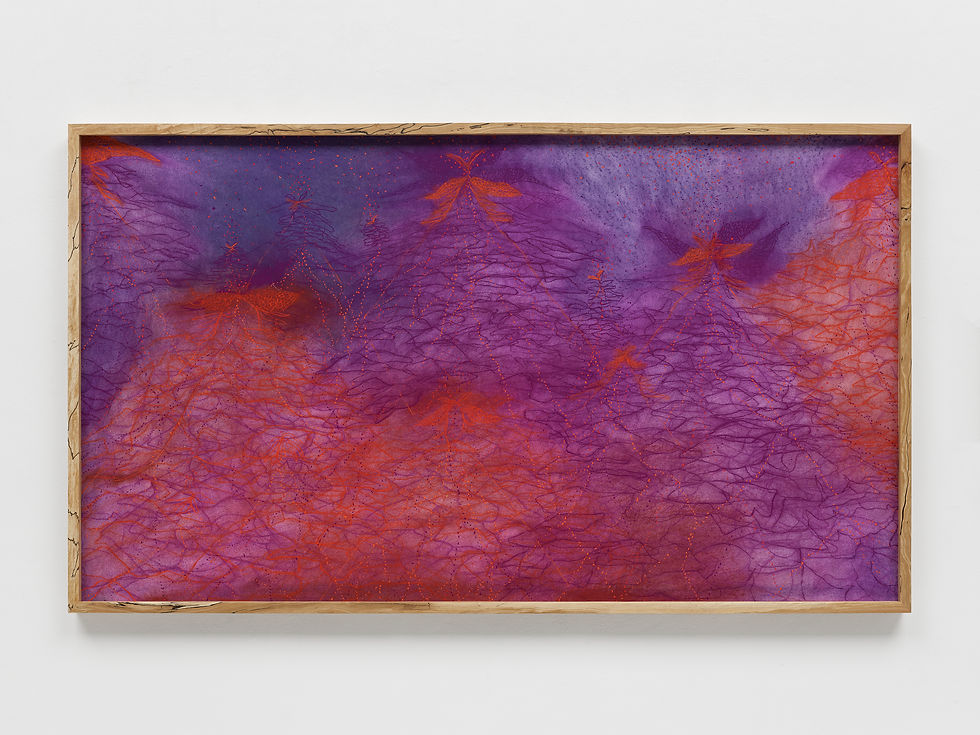
The second show, Revisiting: Fernweh, or Nostalgia for Unknown Lands, is the first international outing for the Irene Y. Panagopoulos Collection, which opened its own space in Athens a year ago with the original version of the exhibition. Curated by Katerina Hadji, this London edition brings together 17 works by 15 artists, most of them shown in the UK for the first time. The names include Marc Chagall, Niki de Saint Phalle, Martin Parr, Brice Marden, Lynda Benglis, Elizabeth Peyton, Bouchra Khalili and Kader Attia.
Fernweh is a German word for a longing for distant places. The show uses it to ask how Greece has been imagined, remembered and reinvented over time. The works span the eighteenth to the twenty-first century, and the artists treat Greece as a cultural and symbolic idea more than a fixed place. You move from Romantic fascination with antiquity to the realities of displacement, and from travel as a search for meaning to the museum as contested ground. The mix of media (sculpture, painting, photography, collage, video, lightboxes and books) keeps it from feeling like a single argument.
Also new at The Hellenic Centre
A brand new café has just opened at the Centre, which gives visitors somewhere to stop between the two shows. It’s meant to become a new hub for the Centre’s community, a place where visitors, artists and audiences can meet, talk about what they’ve seen, and stay on after a talk or screening.

Information
The Hellenic Centre
16-18 Paddington Street, Marylebone, London W1U 5AS
Website: helleniccentre.org