
Centennial Celebration of the Art Deco Mode
—Gabrielle “Coco” Chanel

Robert Bonfils poster for "International Exhibition of Modern Industrial and Decorative Arts", 1925, Kyoto Institute of Technology Museum and Archives
Perhaps, the most influential and compelling design movement in history is the Art Deco. Sweeping the world in the 1920s to 1930s since its debut at the “Exposition internationale des arts décoratifs et industries modernes” held in Paris in 1925, Art Deco has been equated with distinctly geometric linear forms, decorative detailing, vivid color contrasts, and exotic materials such as chrome, lacquer, and rare woods. In fashion, the trend delineates similar qualities in addition to streamlined and symmetrical silhouettes and stylized motifs such as florals, zigzags, and sometimes ancient Egyptian images.
Mitsubishi Ichigokan Museum, Tokyo is presenting “Art Deco and Fashion: Centering on The Kyoto Costume Institute Collection” until January 25, 2026. The artistic movement’s centennial celebration showcases around 310 Art Deco items, including 200 garments, accessories, and documents from The Kyoto Costume Institute (KCI). The institution, established in 1978, collects, preserves, and conducts research on Western costumes and manuscripts. Paintings, prints, and crafts from other museums and local and foreign private collections are also on show.
The retrospective traces the aspects that spurred the birth of Art Deco from post World War I when urban consumer culture flourished in France. In the beginning, the Art Nouveau style, constituting lavish ornamental forms and complicated laces and frills, dominated the fashion scene. With the shift to Art Deco, designs favored straighter lines and finer materials like silk, that tapered the female body outline. During this time, France experienced an expansion in luxury industry imports. Unique and exceptional materials such as animal furs, bird feathers, ivory, jewels, ceramics, and lacquerware poured into the country, together with non-Western patterns and color schemes from the Far East, Middle East, and Africa. The glorious proliferation of novelty was enough to spark curiosity among leading designers.
Among the Paris haute-couture designers featured in the exhibition who turned Art Deco into the face of modern creations, both in decorative arts and industry, were Gabrielle Chanel (1883-1971), Jeanne Lanvin (1867-1946), Paul Poiret (1879-1944), and Jean Patou (1880-1936). A huge gallery hall beautifully parades mannequins clothed in France’s cream-of-the-crop fashion masters’ best collections of the century. Chanel revealed groundbreaking female dress designs that emphasized simple and slender lines deviating from the wide brim hipline. Specifically, she attempted radically to incorporate menswear elements into womenswear, such as slacks, suits, and ties. The bold approach gave the female persona a fresh and ultra-modern appearance, marked by freedom and independence.

Left: Chanel, Evening dress, 1928, Photo: Takashi Hatakeyama
Center: Jean Patou, Evening Dress (part), 1927, Photo: Takeru Koroda
Right: Jeanne Lanvin, Evening dress, early 1920s, Photo: Takashi Hatakeyama.
All dresses from the Collection of The Kyoto Costume Institute
Lanvin was known for her hat shop in 1889 and designs of mother-and-child coordinates. She expanded her fashion house to include sportswear, furs, and interior decoration.
Patou aimed to liberate women from restricted clothing. He shied away from corsets and pioneered jersey swimwear. He also launched sports lines and perfumes.
Poiret, like his contemporaries, revolutionized fashion as well by breaking away from the S-shaped contour. Instead, he stressed the waistline and applied bright and acidic colors to light fabrics.
One significant outcome of the Art Deco movement was the active platform it installed for women creators. Aside from Chanel and Lanvin, Madeleine Vionnet (1876-1975) was also a forerunner in imaginative ladies’ fashion. She produced free-flowing garments without corsets as well. She was recognized for the bias-cut technique, which involved cutting diagonally across the textile grain to enhance more elasticity and to highlight the drape that clings naturally to the body.
The 1920s setting also made travelling by car and train more appealing for women. Hats, bags, luggage, and accessories became lighter and more practical to take along. Shoes also appeared sporty for ease of movement and matched knee-length skirts. The display shelf of decorative jeweled heels exhibited in the large hall is a true feast for the eyes. Visitors will marvel at the meticulous patterns lined with colorful rhinestones, enamel, and metal on wood.
As women’s taste grew more sophisticated and elegant, so did their passion for jewelry, perfume bottle designs, compact powder cases, and wristwatches. René Lalique (1860-1945) was a distinguished icon in this era who elevated glassmaking possibilities. He devised extraordinary shapes and propagated a state-of-the-art technology in decorative arts.
The exhibition also illustrates notable paintings and drawings by Raoul Dufy, Sophie Delaunay, Moïse Kisling, and other artists who greatly inspired modernity, innovation, and freedom of expression during this radiant period.

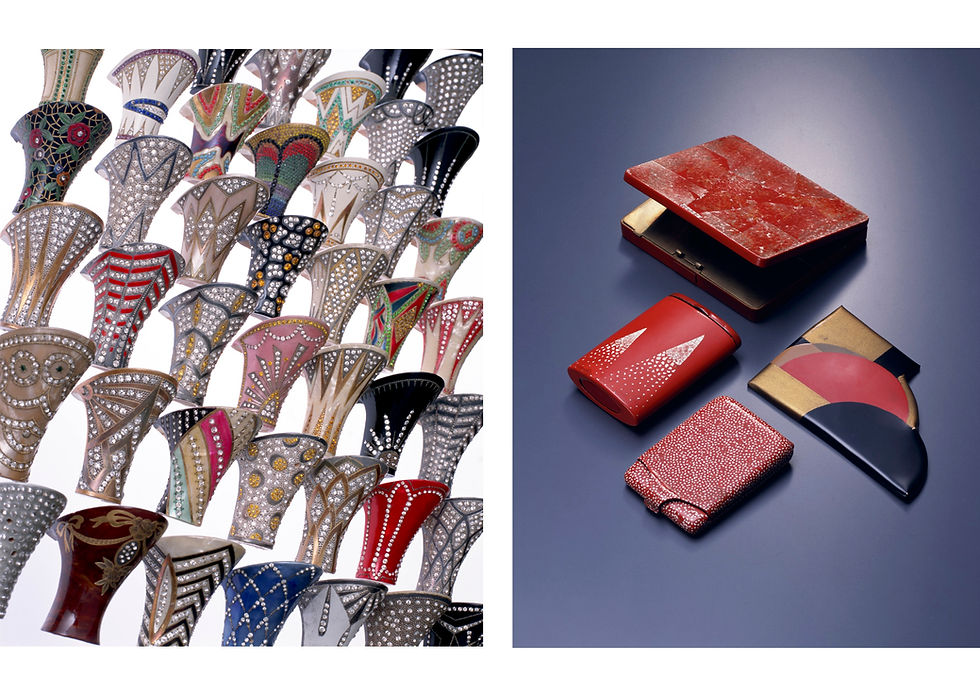
Left:Heels, circa 1925, Photo: Taishi Hirokawa / Right: Jean Dunand Buckle (center right), Compact (top, center left, bottom), circa 1925, Photo: Takashi Hatakeyama.
Both works from the Collection of The Kyoto Costume Institute
Details
Art Deco and Fashion: Centering on The Kyoto Costume Institute Collection
Mitsubishi Ichigokan Museum, Tokyo
Until January 25, 2026
10:00-18:00 (Until 8:00 PM on Fridays, except January 2, the last weekday of the exhibition period, and the second Wednesday of each month)
Closed Mondays except for December 29, January 19, national holidays and substitute holidays, December 31 and January 1
Written by Alma Reyes

