
The Transformative Legacy of Hiroko Koshino
"My mission of drawing is to make people happy, just same as when I make clothes.”

Left: Hiroko Koshino portrait, Photo by ZIGEN
Right: Photo Direction: Ryosuke Uehara, Yoshie Watanabe, Serene Chan, Photographer: Mitsuo Okamoto, Hair & Make up Artist: Hiroko Ishikawa
Alongside fashion legends Issey Miyake and Hanae Mori, Hiroko Koshino has built a transformative legacy that has survived for nearly seventy years. From her childhood exposure to Kabuki and Bunraku, to active participation in international collections, Koshino has successfully tied the knot between Japanese aesthetics and contemporary European cuts. Moreover, her seamless design dynamics fuse fashion with fine arts, incorporating painting techniques directly onto fabrics or applying vibrant, traditional sumi-e brushstrokes.
Being the first Japanese designer to grace the prestigious Alta Moda Roma event in 1978, and to showcase a collection in Shanghai in 1984, Koshino has truly challenged global creativity while nourishing the fundamental aspects of Japanese beauty. In her words, “to do what no one had done before” ultimately encapsulates the essence of her design philosophy.

Opening gallery, Installation view, “(UN)KNOWN HIROKO KOSHINO―New Narratives / True Narratives of Koshino Hiroko―,” Museum of Contemporary Art Tokyo,
Photo ©Yuya Furukawa
Running until July 26 at the Museum of Contemporary Art Tokyo, “(UN)KNOWN HIROKO KOSHINO—New Narratives / True Narratives of HIROKO KOSHINO” presents Koshino’s full retrospective beyond fashion—encompassing, in addition, her unique touch on contemporary painting, sumi-ink painting, music, video, and spatial expression. Through approximately 400 works and materials, visitors can embrace the designer's vision toward reinvention, experimentation, and harmonious cohesion of inevitable social and cultural changes with design.
The first opening gallery beautifully captures both Koshino’s fashion endeavors on one wall, and artistic inclination on the opposite wall. The huge “WORK #1078” (2013), measuring 220 cm x 388 cm, in mixed media—acrylic, pastel, charcoal, jets, Japanese paper, and cloth—is one of her largest and most representative art pieces. Birds soar freely between dazzling, golden mountains against a solid black background, representing a deep, unknown realm. The captivating scene reflects the Japanese spirit of temporal existence, which resonates melodiously with Koshino’s profound sense of energy, movement, and visual expansion. Sandwiched between the walls is the iconic “ECCENTRIC LOTUS” (2008), a sophisticated gown featuring a bold contrast of glistening silver lotus flowers embedded on a spread of pitch-black leaves.

Chapter 1, Installation view, “(UN)KNOWN HIROKO KOSHINO―New Narratives / True Narratives of Koshino Hiroko―,” Museum of Contemporary Art Tokyo, Photo ©Yuya Furukawa
Suddenly, the silence of an open space breaks into a kaleidoscope of colors, shapes, and eclectic images in the first chapter of the exhibition, “Formative Experiences and Imagination—The World of Hiroko Koshino.” A parade of wardrobes assembled from the designer’s early to recent collections converges with her panels of ink, acrylic, and oil paintings; stage curtains for the Kabukiza Theater performances; and videos of her activities, including private scenes such as performing Nagauta (Japanese narrative singing). These provocative textile and art collages revive Koshino’s youthful passion for art, especially amidst the harrowing wartime in Japan. Yet, those bleak shadows of turmoil and devastation have burst into vivid and lavish expressions, setting off an emotional release, as depicted luminescently in this section.
Chapter 2, “Intersecting Aesthetics—Hiroko Koshino and Japanese Modernity,” takes viewers on an explorative journey of the evolution of Japanese art and design, spanning from the postwar era to the phenomenal impact of renowned masters who have shaped society’s cultural identity. These include Tadao Ando, Shiro Kuramata, Ikko Tanaka, Eiko Ishioka, Takashi Murakami, Lee Ufan, Ushio Shinohara, Sadamasa Motonaga, and the Gutai Art Association, which associated proactively with Koshino during her years in Osaka. Their emblematic works are paired with garments fashioned in parallel themes and styles, transmitting a dialogue between art and fashion.
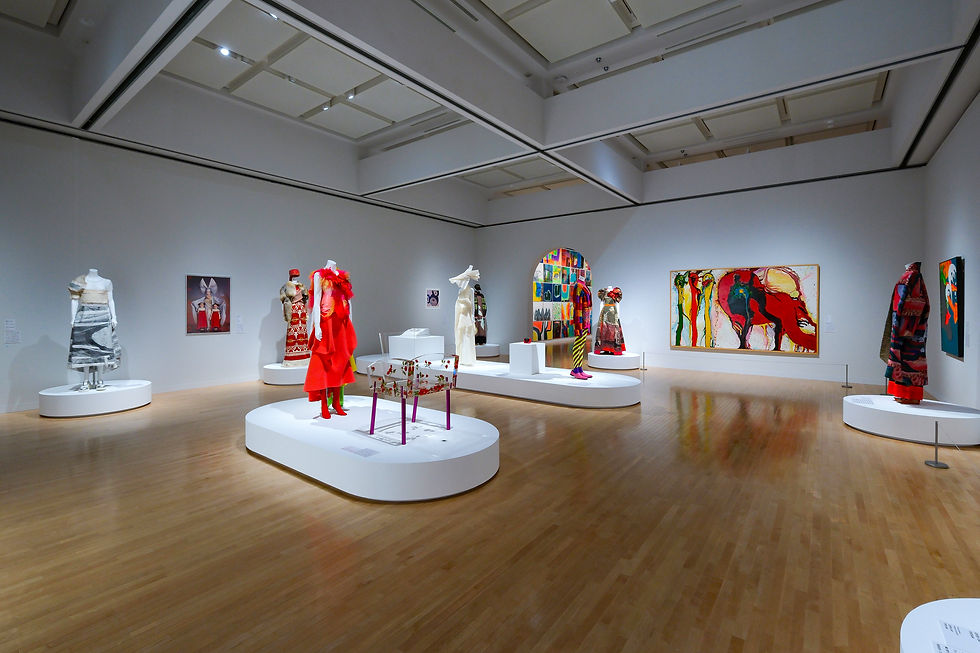
Chapter 2, Installation view, “(UN)KNOWN HIROKO KOSHINO―New Narratives / True Narratives of Koshino Hiroko―,” Museum of Contemporary Art Tokyo, Photo ©Yuya Furukawa
An example is the long dress in horizontal loom, “ORIENTAL BREEZE” (1998), reinterpreting traditional Afghan designs. Koshino adopted oriental and folklore elements woven into a new Western expression. The scarlet red theme balances well with the uniform hues in the popular “Can West Wear East?” poster for PARCO, art directed by celebrated designer Eiko Ishioka. The striking graphic representation delineates Japanese pop culture.
Koshino is also reputed for her extensive collaboration with a wide spectrum of experts—graphic, textile, product, and spatial concept designers, pattern-makers, architects, artists, media, and overall production professionals. Such fruitful efforts generate new structural systems and synthesized philosophies, which support her pursuit to articulate the complexities of human identity. In the third chapter on “Collaboration -Constellations,” a wall-to-wall display of colorful illustrations stands out like a study of color composition—juxtaposing shades that complement and oppose each other. They coordinate with hanging multi-colored garments from Koshino’s past designs and textiles, which were transformed into three-dimensional creations by Paris based contemporary artist Mathilde Denize, recognized for costume paintings.

Chapter 3, Installation view, “(UN)KNOWN HIROKO KOSHINO―New Narratives / True Narratives of Koshino Hiroko―,” Museum of Contemporary Art Tokyo,
Photo ©Yuya Furukawa
More apparel collections line up inside a tantalizing red-themed gallery, “ Passion for Textiles—The Love of Creation.” They emphasize Koshino’s superior weaving, dyeing, embroidery, and painting techniques, as well as advanced processing methods. People can touch and experience the tactile sensation of the fabrics. Surrounding them are evocative photographs of Koshino’s past collections and sketches projected onto the walls.
A special section highlights the Next Creation Program Kids Fashion Project produced by Koshino together with the Tokyo Metropolitan Government and Arts Council Tokyo since 2024. The project encourages children to absorb the creative process of art and design, particularly using textiles. The child-sized mannequins in lively costumes matched with their sketches are truly charming.

Next Creation Program Kids Fashion Project, Installation view, “(UN)KNOWN HIROKO KOSHINO―New Narratives / True Narratives of Koshino Hiroko―,” Museum of Contemporary Art Tokyo, Photo ©Yuya Furukawa
At the gift shop, a wonderful selection of pastel sets in colorful bags distinctly designed by Koshino corresponds to each chromatic pastel artwork. The impressive concept does not merely target consumerism but, as Koshino stated, “creates something that allows people to encounter Hiroko Koshino, the person." Indeed, the exhibition has justified this intention.
Details
“(UN)KNOWN HIROKO KOSHINO―New Narratives / True Narratives of Koshino Hiroko―”
Museum of Contemporary Art Tokyo
Until July 26, 2026
10:00-18:00 (Closed Mondays except July 20 and 21)
Written by Alma Reyes


