
Retracing the Paths of Six Design Maestros
Updated: Jan 24
“To design is to explore one's individual sense of what an independent lifestyle might be.”
—Otl Aicher (“Learning from Design Maestros,” 21_21 DESIGN SIGHT)

Living in today’s world of irresolvable chaos, nonsensical violence, fraudulent information (as a result of polluted social media), as well as an impaired level of empathy poses disconcerting challenges for attaining a positive quality of life. The face of design has also altered dramatically, sometimes, losing its sense of truth and human value as commercialism pervades all facets of industry.
“Learning from Design Maestros,” being presented at 21_21 DESIGN SIGHT in Tokyo until March 8th, hopes to rekindle the fundamental principles and philosophies of design that propelled societies forward and enhanced daily life with beauty and sustainability, as taught by six powerful design masters from the 20th century. Bruno Munari (1907–1998), Achille Castiglioni (1918–2002), and Enzo Mari (1932–2020) from Italy; Otl Aicher (1922–1991) and Dieter Rams (1932– ) from Germany; and Max Bill (1908–1994) from Switzerland showcase their celebrated works, from furniture to accessories, lighting fixtures, tools, household and electronic products, and graphics, which have shaped the backbone of creativity and functionality based on a solid educational and practical design foundation.

These masters hailed from the post-war generation—a revolutionary era that instigated the desire to rebuild mental and emotional strength and foster healthier relations between objects and the economy. Many of them were leading educators who paved the road for future designers to restore order in times of turmoil, and to interject new social insights. Visitors can feel the humanistic elements in each project and the potent influence their design sensibilities instilled in everyday living.
With direction by design journalist Noriko Kawakami and curator and writer Kaoru Tashiro, the exhibition also includes a large-scale video installation by filmmaker and art director Seiichi Hishikawa (DRAWING AND MANUAL), which encapsulates the designers’ endeavors through their own words.
From Milan, Bruno Munari is one of Italy’s most highly respected artists, designers, and inventors who contributed immensely to visual arts, modernism, and futurism. He is greatly renowned for his kinesthetic learning approach involving hands-on and sensory experiences, particularly in his children’s books and toys created in collaboration with the Italian design company, Danese Milano. His creative activities were full of irony and humor and mobilized art across multiple dimensions. Possessing a childlike mind and instinct for imagination was indispensable to inspire initiative and novelty.

Munari formed strong friendships with several Japanese designers, such as Takashi Kono and Shigeo Fukuda. His books were first published in Japan by Bijutsu Shuppansha with translations by Masanao Uematsu. His extensive collaboration with the tile company, Dantousha, in the 1970s led to bold innovations in visual expression.
On display is his “Falkland” (1964) suspension lamp that comprises components of contrasting forces. It induces tension in the stretched tube made of finely woven fabric and the weight of the differently sized metal rings. The shades’ undulating curves in varied heights are utterly exquisite.
Another Milanese designer, Achille Castiglioni, studied architecture at the prestigious Polytechnic University of Milan, like his brothers Livio and Pier Giacomo. The brothers launched their design studio focused on furniture, lighting apparatus (such as “Taccia,” 1962 and “Arco,” 1962), and everyday items. Castiglioni developed a deep passion for all forms of illumination. His in-depth research on light bulbs—their placement, and methods and degrees of light diffusion—was impeccable. Some of his creations were labeled as eccentric or humorous, but each piece imbued self-expression that progressed from observation to discovery. These features identified his philosophy of “progettazione,” which was a constant and consistent way of addressing problems through intense curiosity.

Enzo Mari was introduced to Danese Milano by Munari. He engaged in more than 2,000 projects, ranging from experimental to mass-produced products. His educational workshops (including those in Hasami, Nagasaki) guided craftspeople to think independently and initiate new traditions through intercommunication with local people and other creators. In 2002, Mari launched a furniture collection with MUJI with a mission to “remove all unnecessary and unnatural elements, without falling into fundamentalism.”
The “Samos” porcelain series on show used modulated slab-building and coiling by hand. This method transformed imperfections, like unintended marks, into decorative accents.
For the “Timor” desk calendar, Mari was inspired by railway signage. He affixed PVC cards for the days, weeks, months, and dates to a central pivot so they can be fanned out according to the user’s preference.
Widely recognized for furniture and watch design, Max Bill studied with Paul Klee and Wassily Kandinsky at the Bauhaus before co-founding the Ulm School of Design in Germany with Inge Aicher-Scholl and Otl Aicher. As an architect, artist, designer, and academician, he was a firm advocate of the environment’s vital impact on creativity. The corrugated and flowing shapes of his objects illustrate the concept of “Product Form,” which highly considers format, material, and production processes in achieving efficacy in beauty.
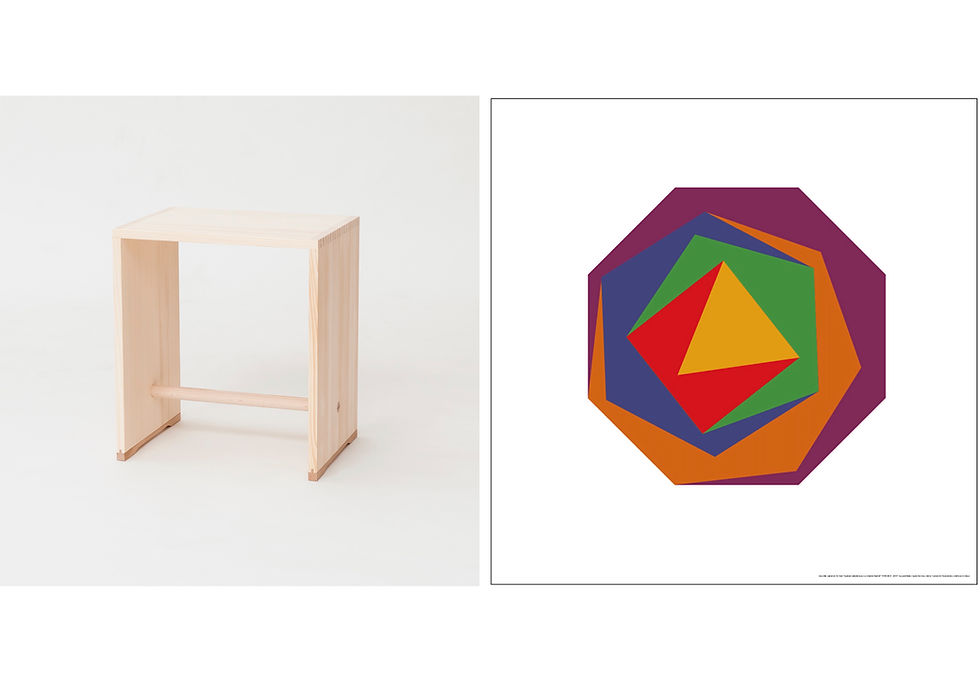
The “Ulm Stool/Ulmer Hocker” (1954) utilizes various woodworking techniques to connect the seat and the sides. Its multipurpose function serves not only the classroom and the home, but also the transport of books and tools.
He perceived the idea of “mathematical thinking in contemporary art” as a means of converting invisible ideas into a pure structure and a rhythm to enforce the relationship between color and form. This theory is evident in the chromatic “15 variations on a single theme” (1935–1938).
In graphic design, Otl Aicher is best remembered for his total design production of the 1972 Munich Olympics and the art direction and signage for the Frankfurt International Airport and Lufthansa. For the Munich Olympic Games, he formulated multi-colored, systematic, and flexible visual identities that fueled the principle of kinship. Aicher's sense of visual communication promoted cultural expression rather than profit-oriented commercialism. His proactive leadership in co-establishing the Ulm School of Design asserted his passionate and constant exploration of relationships among diverse environments, societies, and lifestyles.
Lastly, the exhibited “SK 5” Phonosuper Tube Radio Record Player (1958), “ET 66” (1987) calculator, and other industrial products from Braun by Dieter Rams evoke a tinge of nostalgia. Both as an engineer and a designer, Rams devised products that echoed logic, detail, precision, and excellent material choice. He outlined the 10 Principles for Good Design that stressed innovation, aesthetics, honesty, and environmental friendliness, among others.
The overall exhibition reminds us of the true essence of original design in its cardinal goal to improve and inspire daily livelihood.
Details
“ Learning from Design Maestros”
21_21 DESIGN SIGHT
Until March 8, 2026
10:00-19:00 (Closed Tuesdays)
Gen De Art
by Alma Reyes


