Science, Freedom and ResponsibilityInside the Lindau Nobel Peace Dialogue at the 75th Lindau Nobel Laureate Meeting
Lindau, Germany
The 75th anniversary of the Lindau Nobel Laureate Meetings did not begin with a breakthrough in physics, chemistry or medicine. Instead, it opened with a question that reaches beyond scientific disciplines: What conditions allow science to flourish?

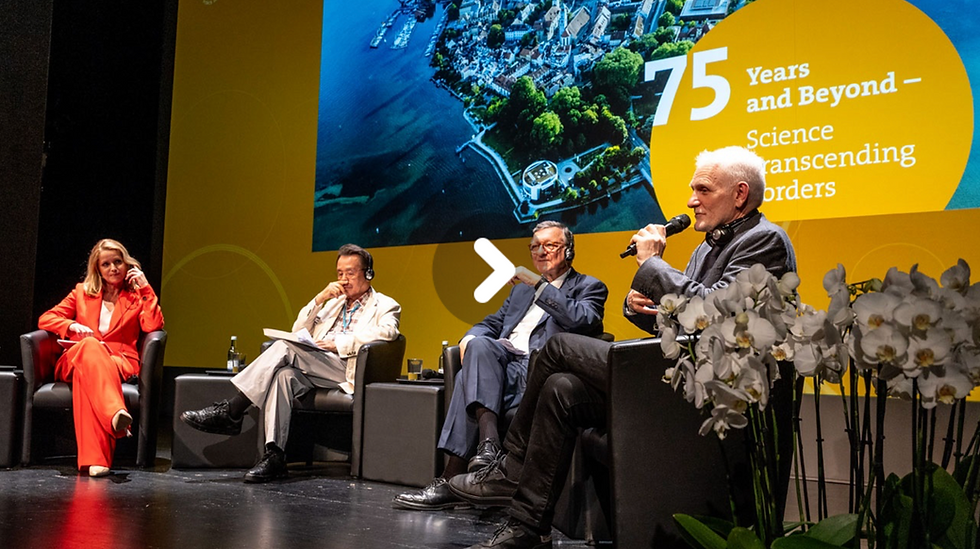
On 27 June, one day before the official opening of the anniversary meeting, the Lindau Nobel Peace Dialogue brought together Nobel Peace Prize laureates, former leaders of the European Union and the United Nations, scholars, and members of the public at Lindau’s historic Stadttheater. Rather than discussing research itself, the forum explored the relationship between freedom, democracy, human rights and scientific responsibility, offering a broader perspective on the values that have shaped the Lindau Meetings since their founding in 1951.
Welcoming participants on behalf of the Council for the Lindau Nobel Laureate Meetings, Countess Bettina Bernadotte opened the anniversary programme before inviting Lindau Mayor Claudia Alfons to reflect on the history of the Meetings. Her role was deliberately brief. The dialogue itself—not ceremony—was intended to become the opening statement of the anniversary year.
A Legacy Born from Dialogue

In her keynote address, Mayor Claudia Alfons returned to the origins of the Lindau Meetings in post-war Germany. The country was emerging from destruction, scientific communities had been divided by war and political ideology, and trust among nations had largely collapsed. Against this background, two physicians from Lindau, Franz Karl Hein and Gustav Wilhelm Parade, envisioned inviting Nobel laureates back to Germany—not simply to discuss scientific discoveries, but to rebuild dialogue where conflict had broken it.
From the first meeting in 1951, attended by seven Nobel laureates and around 400 scientists, Lindau gradually evolved into a unique international platform. Alfons recalled the symbolic reunion between physicists Max Born and Werner Heisenberg, whose wartime separation came to represent the possibility of reconciliation through scientific exchange. She also highlighted the 1955 Mainau Declaration against nuclear weapons and the 2015 Mainau Declaration on Climate Change, illustrating how the Lindau Meetings have consistently expanded scientific discussion into questions affecting humanity as a whole.
Her message was clear: the history of Lindau has never been solely about scientific excellence. It has always been about rebuilding trust through dialogue.
Freedom as the Foundation of Scientific Exchange
If the historical perspective explained why the Lindau Meetings were created, Ales Bialiatski, the 2022 Nobel Peace Prize laureate from Belarus, demonstrated why those founding principles remain relevant today.
Appearing publicly only months after his release from prison, Bialiatski offered a deeply personal reflection on years spent under harsh detention. He described prison life as a daily struggle for basic human dignity, where access to information, communication and even sunlight became limited. Speaking quietly but firmly, he explained that receiving the Nobel Peace Prize had not changed the conditions of his imprisonment. What it changed was his inner conviction.
“The Nobel Prize gave me inner confidence,” he said.
Equally significant was his insistence that the award did not belong to him alone.
“It was given to the Belarusian people.”
Throughout his remarks, Bialiatski repeatedly shifted attention away from himself toward colleagues who remain imprisoned. His testimony transformed the discussion of freedom from an abstract political concept into a human experience. In doing so, he reminded the audience that scientific inquiry, intellectual independence and free exchange of ideas all depend upon freedoms that cannot be assumed.
Science Requires Responsibility
Former President of the European Commission José Manuel Barroso, who accepted the Nobel Peace Prize on behalf of the European Union in 2012, approached the discussion from a different perspective. Drawing on philosopher Baruch Spinoza, he argued that peace should not be understood merely as the absence of war, but as a condition built upon freedom, tolerance and respect for human dignity.
Reflecting on Portugal’s transition from dictatorship to democracy, Barroso spoke of growing up in a society where books were censored and political freedom was restricted. The desire simply to read forbidden literature, he recalled, became one of the motivations that shaped his generation’s political consciousness.
Yet his most striking argument concerned science itself.
Education, he cautioned, does not automatically produce peace or democracy. Germany before the Second World War was among the world’s most highly educated societies, yet totalitarianism still emerged there. Knowledge alone therefore cannot guarantee ethical progress.
As artificial intelligence and other transformative technologies reshape the twenty-first century, Barroso argued that scientific achievement must be accompanied by moral responsibility. Quoting German sociologist Max Weber, he called upon scientists to embrace an “ethos of responsibility,” insisting that intelligence without ethical responsibility cannot secure a peaceful future.
International Cooperation Under Pressure
Former Prime Minister of the Republic of Korea and former President of the United Nations General Assembly Han Seung-soo shifted the discussion toward global governance.
Recalling his election as President of the General Assembly on 11 September 2001, the day of the terrorist attacks in the United States, Han described assuming leadership during one of the most turbulent moments in modern international politics. While acknowledging that the United Nations faces increasing political divisions and institutional challenges, he maintained that no other global organisation is capable of replacing it.
Climate change, sustainable development, conflict and humanitarian crises, he argued, all require cooperation that extends beyond national borders. Although imperfect, international institutions remain indispensable for maintaining dialogue in an increasingly fragmented world.
Together, the three speakers presented complementary perspectives. Bialiatski focused on individual freedom, Barroso on democratic responsibility, and Han on international cooperation. Each approached peace from a different direction, yet all returned to a common conclusion: scientific progress cannot be separated from the social and political conditions that allow knowledge to be shared openly.

Preparing the Next Generation
The dialogue concluded by turning attention to the more than 600 young scientists from over 100 countries arriving in Lindau for the anniversary meeting.
Moderator Astrid Frohloff described the Lindau Meetings not as a place where Nobel laureates lecture students, but as a space where both generations meet “as partners in conversation.” That philosophy has distinguished the Meetings for seventy-five years.
Asked what advice they would offer the next generation, the speakers shared different perspectives but arrived at remarkably similar conclusions. Bialiatski encouraged young researchers to value international exchange. Han hoped they would return home with renewed confidence and a stronger sense of global responsibility. Barroso urged them to recognise that scientific excellence alone is not enough; the defining challenge for today’s researchers is to combine innovation with ethical judgement.
Beyond the Anniversary
The Lindau Nobel Peace Dialogue served as more than a ceremonial prelude to the 75th Lindau Nobel Laureate Meeting. It explained why the anniversary chose to begin with peace rather than scientific achievement.
Seventy-five years ago, the Meetings were founded to rebuild dialogue in a fractured post-war Europe. Today, facing geopolitical tensions, rapid technological transformation and growing uncertainty about international cooperation, the same questions remain strikingly relevant.
Before scientific discovery comes freedom.
Before innovation comes responsibility.
And before science can shape the future, societies must first preserve the conditions that allow knowledge to cross borders, generations and cultures.
That enduring commitment to dialogue remains one of Lindau’s greatest contributions to the international scientific community.