
Sophie Whettnall: Tracing the Invisible
Updated: Jul 23, 2025
In an era of hyper-visibility—of relentless exposure, loud declarations, and digital over-saturation—Sophie Whettnall’s art offers a necessary counterpoint: an invitation to pause, perceive, and sense what slips between certainties. Her latest solo exhibition, InVisible, now on view at Michel Rein Gallery in Paris, is a quiet, powerful meditation on fragility, transformation, and the poetics of disappearance.
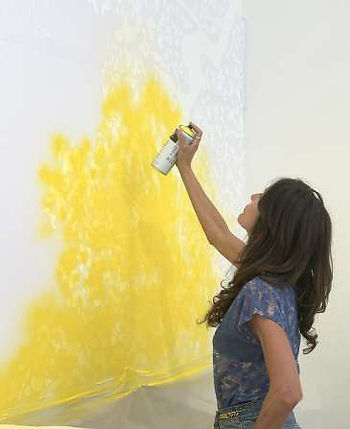
For over two decades, the Belgian artist has been exploring the tension between presence and absence. Whether through sculpture, video, or ephemeral installations, Whettnall is drawn to what resists immediate understanding. Her work favors slowness over spectacle, ambiguity over assertion. InVisible deepens this inquiry, unfolding as a kind of whispered manifesto for the seen and the unseen.

Teatrino, 2025 copper cuivre 30 x 60 cm (11.81 x 23.62 in.)unique artwork © Florian Kleinefenn
“Invisibility isn’t absence,” Whettnall tells Gen de Art. “It’s a presence that requires attention. I’m interested in what resists immediate perception: the subtle, the quiet, the fragile. By obscuring or erasing parts of an image or gesture, I try to invite the viewer to look differently, more slowly—to enter into a space where meaning is not fully given, but sensed.”
This invitation is perhaps most literal in her delicate satin and silk works, part of two new series titled Invisible Landscape and Shifting Landscape. Hanging like suspended breaths, these prints (nothing is printed on those pieces , the silk is just perforated) are simultaneously object and apparition—sensitive surfaces that catch the light and, with it, the viewer’s gaze.
“Satin evokes a certain intimacy,” she explains. “It’s often worn beneath something, not immediately visible, which adds a layer of hidden presence. It reflects light in a way that allows the fabric to almost become a living entity, changing with its environment. That quality of constant transformation felt important for my exploration of invisibility and perception.”
The materials are deeply symbolic, too. Whettnall’s choice to work with fabrics traditionally associated with femininity—skin, intimacy, sensuality—turns the works into quiet acts of feminist resistance.
“These are fabrics traditionally associated with the body, with intimacy, even with fragility or luxury. By working with them, printing, puncturing or piercing ghost-like forms or almost invisible gestures, I wanted to question how women’s histories, bodies, and memories have often been rendered invisible. The fabric becomes a kind of skin, a sensitive space where presence and absence coexist.”
This interweaving of material and metaphor continues in her sculptural series Layer Cake, where Fontainebleau stone, Indian ink, and copper are stacked into totemic strata. The result is a kind of geological palimpsest—anchored in time, but always on the verge of transformation.
“Each material carries its own history and energy,” Whettnall says. “The Fontainebleau stone is a geological body shaped by erosion and memory. When I paint on it with ink, I’m adding a human, almost calligraphic gesture onto something ancient. The copper introduces another layer—something conductive, crafted, industrial. Together, they’re like time markers: the rock as deep time, the ink as the present gesture, the copper as something in-between.”
Nowhere is her conceptual clarity more breathtaking than in the Ratrack Project, a monumental video work that transforms a snow grooming machine into an ephemeral drawing tool. Conducted in the Alpine landscape, the performance blends choreography, engineering, and chance into a single, impermanent mark.
“I had to learn how the machine worked—and build a real complicity with the driver, so he could become the extension of my gesture. What emerged was a shared choreography between human, machine, and landscape. The drawing exists only for a moment, like a memory traced in the snow. Chance played a major role, as it often does in my work.”
It’s a haunting idea: that art, like memory, is most potent in its impermanence.
Layer cake, 2025
grès stone from Fontainebleau, Indian ink, copper, wood
pierre de grès de Fontainebleau, encre de Chine, cuivre, bois
© Florian Kleinefenn
In InVisible, Whettnall doesn’t merely represent the overlooked—she renders the act of seeing itself an open question. To encounter her work is not to consume a message, but to receive a sensation. To understand less, perhaps, and feel more.
In a world desperate to be seen, Sophie Whettnall reminds us that some truths reveal themselves only when we stop looking.
D'une rive, l'autre, 2024
Projet Conflans-Sainte-Honorine
bottle-green colored metal structure and aluminumstructure métallique colorée vert bouteille et aluminium
250 x 750 x 250 cm (98.43 x 295.28 x 98.43 in.)unique artwork
© Florian Kleinefenn
MICHEL REIN Paris42 rue de Turenne 75003 Paris France
MICHEL REIN Brussels Washington rue/straat 51A 1050 Brussels Belgium


