
STPI Unveils New Works by Thai artist Udomsak Krisanamis at Art Basel in Basel 2026
Singapore’s STPI presented a solo booth of works by Thai artist Udomsak Krisanamis at Art Basel in Basel, marking the debut of a major new body of work developed through the institution’s renowned artist residency programme.

Widely regarded as a pioneering figure in Thailand’s contemporary art scene, Krisanamis (b. 1966, Bangkok) has long explored the intersections of memory, popular culture and abstraction. For his presentation with STPI, the artist reimagines the mediums of print and paper through a series of richly layered works that retain the visual density and tactile complexity for which he is known.
The fair presentation brought together fragments of global popular culture—among them references to Coca-Cola and the nineteenth-century Hungarian composer Franz Liszt—to reflect on what Krisanamis describes as shared experiences of contemporary life. The artist approaches these images not as nostalgic quotations but as enduring cultural forms that continue to resonate across generations. These works will anchor the artist’s major presentation at STPI to be held in Singapore in 2027.
“Popular images are like pop songs,” Krisanamis says. “People liked them a long time ago, but we still listen to them today. They continue to inspire.”
Such references have appeared throughout the artist’s practice, which is characterised by bold collage-based compositions incorporating found materials and everyday objects. In the new works, familiar motifs emerge and dissolve within kaleidoscopic fields of colour and texture, producing optical effects that invite sustained looking. The resulting abstractions function less as representations than as sensory experiences.
The project stems from Krisanamis’s recent residency at STPI in Singapore, where he spent several weeks collaborating with the institution’s master printers and papermakers. The residency enabled the artist to extend his visual language through techniques and material processes unavailable within the confines of his own studio in Chiang Mai.
“They are incredibly professional,” Krisanamis says of STPI’s team. “I explain what I want—the effect, the texture, how an image should feel—and they can realise it. The process itself became very inspiring.”
Established in 2002, STPI has developed an international reputation for its experimental residency programme, inviting artists from around the world to collaborate with specialist artisans and create works in print and paper that push the boundaries of both mediums. To date, the organisation has worked with more than one hundred artists internationally.
Left: Udomsak Krisanamis, Thinking of Liszt VI, 2026, Screenprint on STPI handmade paper, 108 × 79.5 cm. © Udomsak Krisanamis / STPI. Image courtesy of the artist and STPI, Singapore.
Right: Udomsak Krisanamis, X-treme, 2026, Photo transfers, acrylic paint on linen canvas, 66.5 x 59 x 2.5 cm. © Udomsak Krisanamis / STPI. Image courtesy of the artist and STPI, Singapore.
According to STPI’s Executive Director, Emi Eu, presenting Krisanamis’s project at Art Basel serves both as a preview of the forthcoming exhibition and as a strategic platform for promoting artistic practices from Southeast Asia on an international stage.
“Art Basel is an international affair, but it remains predominantly European and American in its orientation,” Eu says. “It is therefore an important opportunity for us to showcase and promote artists from our part of the world.”
Eu emphasises that STPI’s role differs from that of a conventional commercial gallery. Rather than representing artists exclusively, the institution focuses on presenting and advancing the collaborative projects developed through its residency programme. The process itself is central to the resulting works.
“The residency provides a very fertile ground for creativity to flow,” she says. “It is experimental, research-driven and based on dialogue between the invited artist and our printers and papermakers. Together, they push each other beyond their respective limitations.”
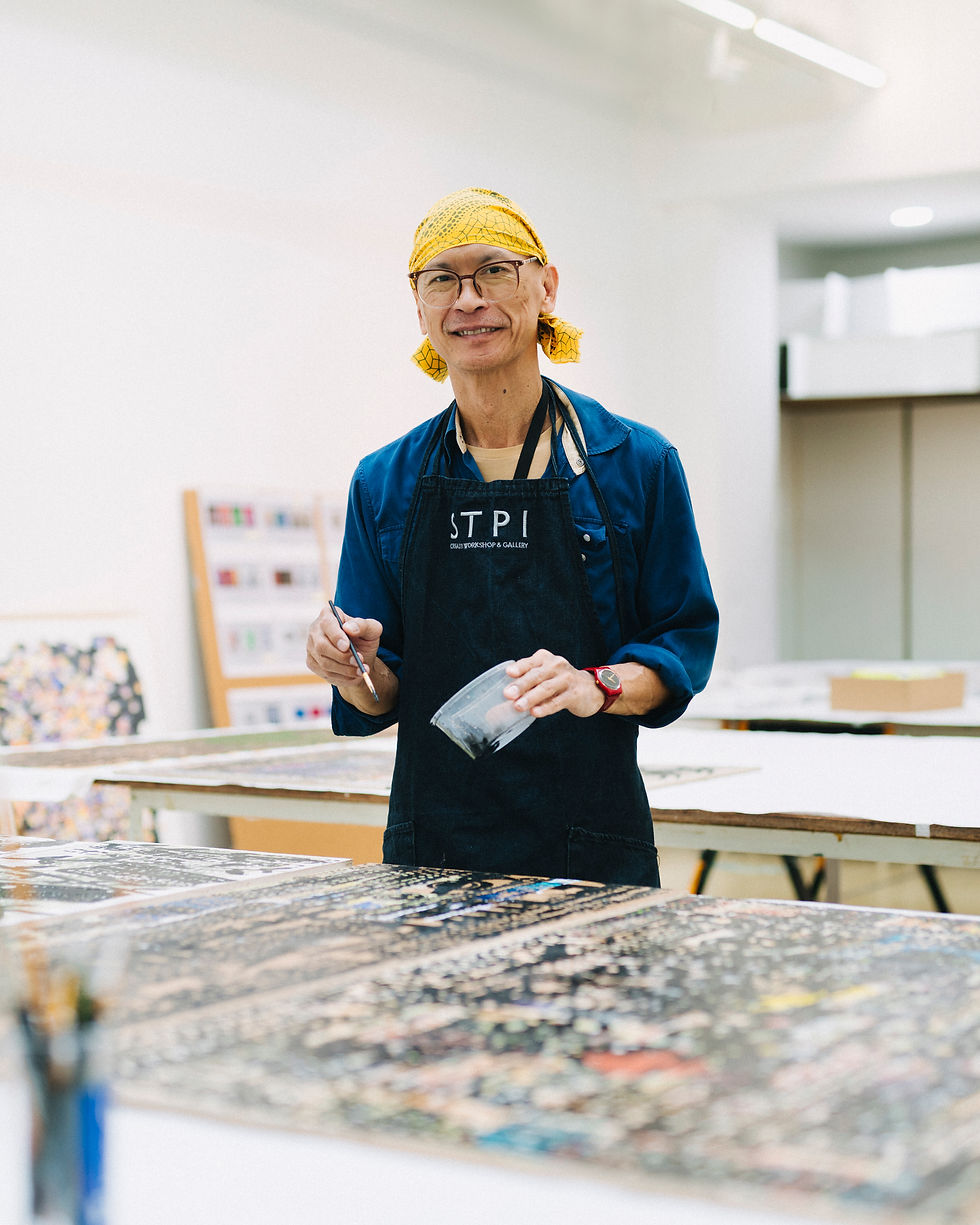
At Art Basel, the presentation has attracted visitors through its striking installation and its unexpected iconography. Those familiar with classical music immediately recognise the image of Franz Liszt, while others are drawn by the depth and complexity of the works’ surfaces. Questions frequently return to process: how screen printing, handmade paper and layering techniques have been employed to achieve such rich visual and material effects.
The booth ultimately positions Krisanamis’s practice within broader conversations around cultural circulation and artistic exchange. By transforming globally recognisable symbols into densely textured abstractions, the artist demonstrates how images from popular culture can become sites of collective memory and contemporary reflection.
For Krisanamis, however, the ambition remains straightforward. As Thailand’s contemporary art ecosystem continues to expand and gain international visibility, he hopes simply for deeper engagement with audiences and collectors worldwide.
“We need more collectors to collect art,” he says. “Hopefully there will be more support. But for now, I would say: just enjoy the show.”


