
The Magic and Immersive Art of Tony Oursler
Updated: Aug 11
“There’s so much magical thinking around technology.” —Tony Oursler

Complementing the vibrant shades of summer, “Tony Oursler: Tech/Gnosis-Magic, Media, Art,” an immersive exhibition by multimedia artist Tony Oursler, is currently being presented at the TOKYO NODE GALLERY until September 27th this year. It marks the creator’s first major retrospective in Japan.
Oursler began exploring video art in the mid-1970s. He quickly achieved critical acclaim by using projectors to embed stylized facial expressions, such as joy, sadness, sarcasm, or humor onto inanimate objects. His multidimensional installations fuse video, sculpture, sound, light, and words to represent a wide range of subjects, including pop culture, subculture, science, technology, conspiracy theories, the paranormal, spirituality, and the cosmos.
Through approximately fifty tantalizing works and about 200 selected items from the Tony Oursler’s Archive, visitors learn to “challenge the boundaries between the visible and the invisible, and between faith and technology.” As artificial intelligence, reconnaissance and surveillance systems, robotics, and other forms of cutting-edge technology transform our sense of perception and judgment, we struggle increasingly to separate science from religion, reason from irrationality, and ambiguity from transparency. Oursler aims to engage viewers in these complex realities and trigger an awareness of what it means to see and to believe.
The term “tech/gnosis” connotes the intersection of human spirituality, the occult, and digital technology, centering around a gnosis (Greek word for knowledge)—an awakening to how these elements pervade our material world. For Oursler, our obsession with the virtual realm essentially emulates contemporary modes of magic or spiritual connection.

Stretching fifteen meters high, the dome-shaped space at the TOKYO NODE GALLERY provides the ideal setting for Oursler’s large-scale structures, which also aligns perfectly with the artist’s vision of an “incubator” for creative experiences. He remarks, “I have always associated Japan with high-tech experimentation as well as a deep and complex history. That balance feels especially important today, as we navigate powerful new technologies—extraordinary tools that also challenge our sense of human nature.” (“Tony Oursler: Tech/Gnosis-Magic, Media, Art,” TOKYO NODE GALLERY)
The first section of the exhibition instantly transports visitors to a dark constellation of enormous, floating eyeballs. Initiated in 1995, “Specular” (2021) continues Oursler’s exploration of the “eye” motif projected in 4K onto giant spheres. It prompts viewers to visualize the experience of “peeking” and “being seen.” The corneas and irises of the eyes transmit thoughts related to energy crisis controversies, moon landing denial, the Illuminati, 5G effects, COVID causation, and other debatable issues. This artwork parodies the human desire to consume images and stories insatiably, as evidenced by our exploitation of social media today. Furthermore, the spacious hall evokes a stimulating effect of seeing ourselves within the simulated eyeballs.
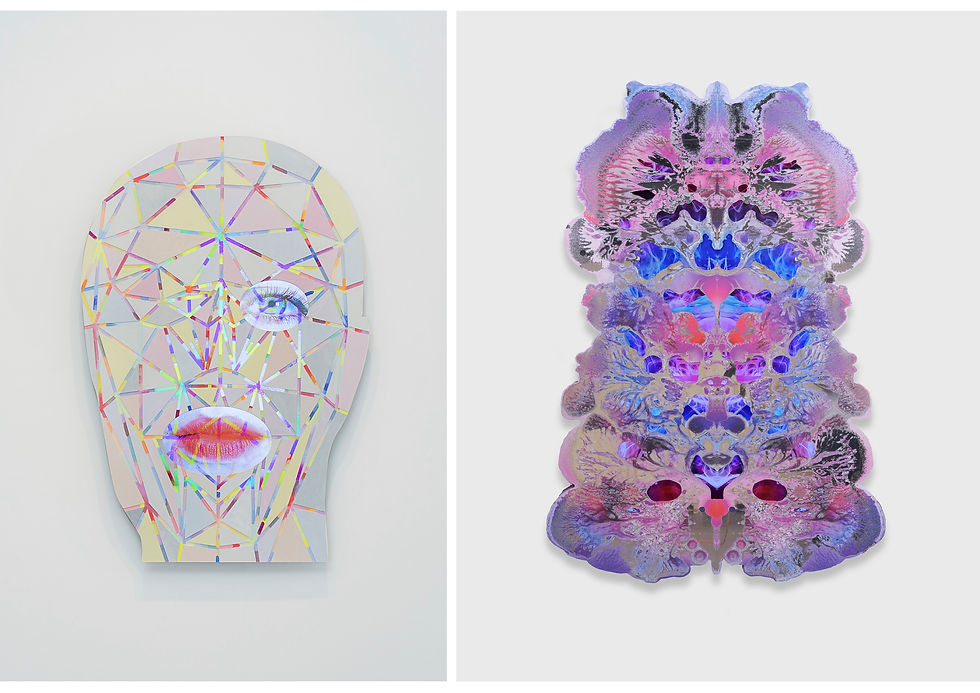
Two intriguing works, “MUR (dusk)” (2022) and “C>o++” (2017), demonstrate the consequences of facial recognition and surveillance technology as utilized today. “MUR (dusk)” derives from the Rorschach test developed in the 1920s, which dissects the psyche through enigmatic imagery. Mirrored, kaleidoscopic graphics swim across a reflective metal surface, provoking hallucinations that reconstruct perception into diagnostic material. Similarly, “C>o++” magnifies portraiture beyond the mere delineation of a face’s outline. Incorporating LCD screens and sound, the talking portrait employs facial recognition and biometrics to capture expansive data about a person.
Another mesmerizing room explodes with a labyrinth of meta-installations flashing chattering and moving pictures. “Lock 2, 4, 6” (2010) questions the limits of consciousness as a medium of desire, fear, obsession, or unstable behavior striving for balance. The concept interprets cognitive psychologist Peter Wason’s experiment on confirmation bias, which analyzes a person’s tendency to defy accurate information by favoring a preexisting belief. Viewers become participants in the analytical process as three interrelated systems—mind, body, and the unknown—interlock on corresponding displays through narratives by a man, a woman, and a ghoul.
The next hall is equally powerful in its visual effects. In “mAcHiNe E.LF.” (2023), Oursler devised a series of “electrified” silhouettes consisting of painted and printed collages, geometric mirrors, and dichroic refraction screens cast onto colorful crystal structures. As sculptural objects, they emit a web of overlapping colors depending on the viewer’s perspective. Crystals, being essential components of telecommunication and computer processes, also stem from ancient stones, used for healing, protection, and the release of spiritual energy. The glistening forest of beams and reflections examines how present technology merges with mystical symbols. Numerous artists and performers participated in this piece—including Constance DeJong, Jim Fletcher, and Jason Scott Henderson.
One of the special highlights of the exhibition, making its world premiere, is Oursler’s collaborative work “Empty” (2000), created with celebrated performer David Bowie. The two visionaries started joining forces in 1999, sharing common interests in art, psychological behavior, and imaging technology. The luminous work gathers four massive, iconic heads of Bowie, rendered in psychedelic animation, and beams them onto egg-shaped monoliths as he recites Oursler’s poetic texts alongside a musical score by composer Glenn Branca. Oursler applied the multi-layered imaging technology of the “camera obscura” (the optical phenomenon of light passing through a tiny hole in a dark room to produce an inverted or reversed image on a surface) as a tool to alter the human body and the psyche. Bowie fans can especially cherish the singer-songwriter’s nostalgic appearance through art.

In 2003, Oursler became fascinated by a mainstream trend of Japanese children raising virtual pets on digital devices. This inspired him to innovate a sophisticated high-resolution photographic technique to design diverse characters—including a smiley face, the goddess Venus, Japanese manga figures, and the popular Tamagotchi—on amorphous sculptures. The result was “Caricature" (2003-2004), a series of stretched, twisted, and ghastly faces, reminiscent of Dadaist or Surrealist grotesque life forms existing in a digital realm. While the accompanying dialogues may sound entertaining and humorous, they also mimic disturbing content, portraying the unsettling, subconscious presence of media in everyday life.
As Oursler’s latest feature, conceived intentionally for this exhibition, “Chimera” (2026) consolidates radiant trees, cryptids, UFOs, urban legends, and other mythical creatures hovering above a utopian digital woodland. The artist insinuates that human evolution has shifted from spiritual beliefs to a cyber environment that acts as a modern representation of the occult. Visitors gaze at the ecosystem vanishing into dreams and fears while contemplating the instinctive essence of nature.
Some rooms also showcase video screenings about stage magic, pseudoscience, fabricated theories, and contemporary mythologies, which define how we understand the world we live in.
The exhibition offers exclusive gallery tours, a Night Museum, a Kids’Workshop, a talk show, and other events. Check the website for schedules and details.

Details:
“Tony Oursler: Tech/Gnosis-Magic, Media, Art”
Tokyo Node GALLERY A/B/C
Until September 27, 2026
10:00–19:00 (until 20:00 on Fridays and Saturdays); Last admission is 30 minutes before closing. Exhibition dates, opening days, and opening hours are subject to change.
Please check the website for the latest information.
Written by Alma Reyes


