From Young Scientist to Nobel Laureate Returning to Lindau After 50 Years and Two Months: Michel Devoret on the Nobel Prize, Scientific Responsibility, and the Next Generation
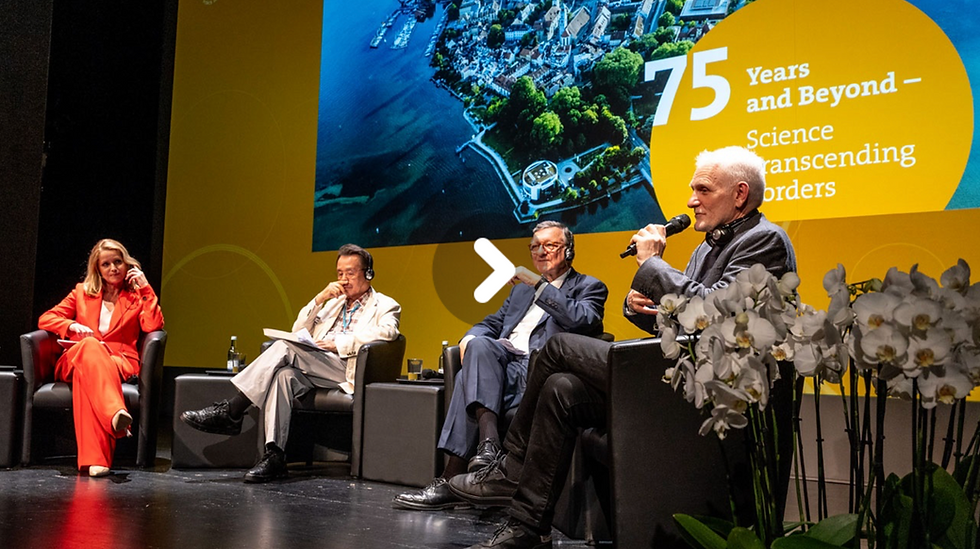
At the 2026 Lindau Nobel Laureate Meetings, I had the opportunity to speak with Michel Devoret, recipient of the 2025 Nobel Prize in Physics.
The interview marked our second meeting. We first spoke in Stockholm during Nobel Week in December 2025, shortly after the Nobel Prize ceremony. Six months later, we met again in Lindau to discuss how life has changed since the Nobel Prize, his return to the meeting exactly 50 years and two months after attending as a young scientist, and the advice he hopes to pass on to future generations.
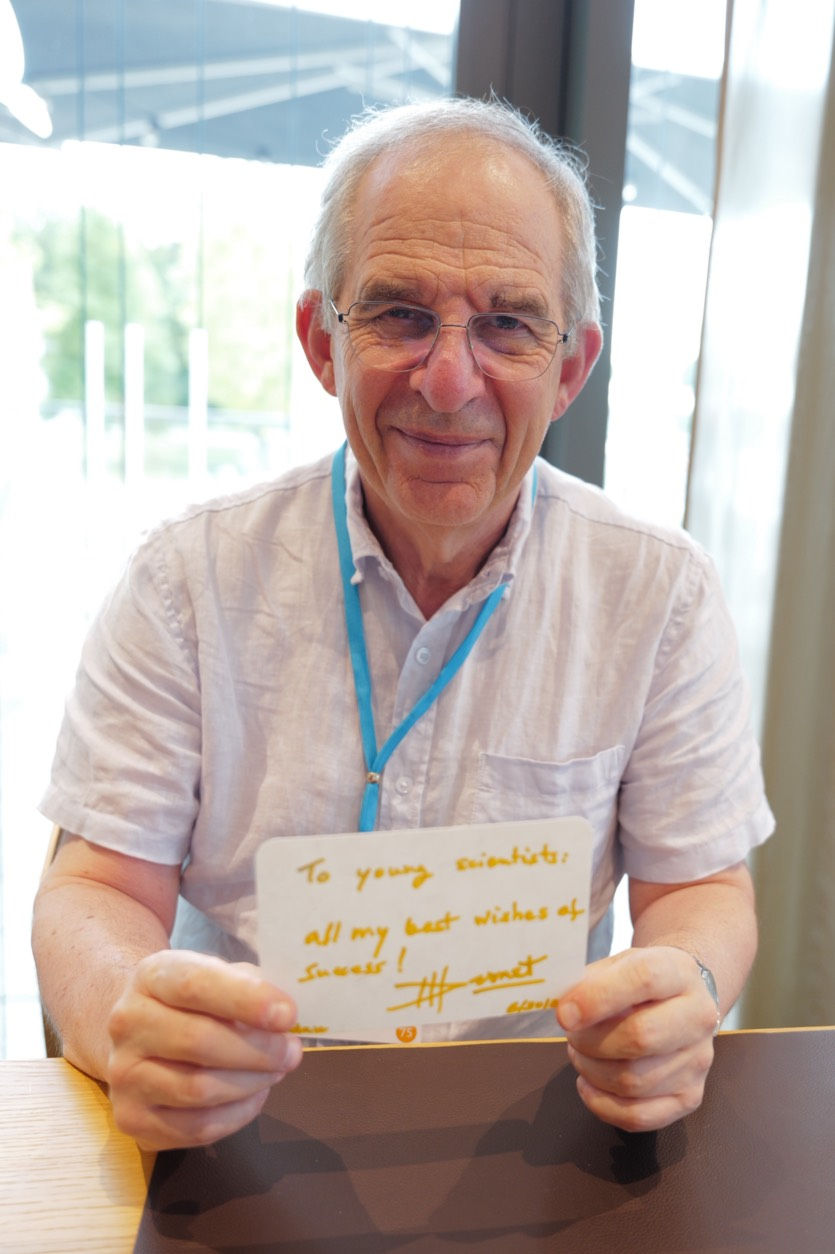
“The Nobel Prize changed my life—but I also lost a little freedom.”
When asked what had changed most after receiving the Nobel Prize, Devoret did not mention research first.
“The biggest change is that I have become a public person.”
He explained that people no longer see him simply as a physicist.
“Society expects Nobel laureates to behave in a certain way. You become a public figure, and you lose some of the freedom you had before.”
That change, he said, also brings responsibility.
“Before, if I spoke about something outside my expertise and made a mistake, it was not a big problem. Now people take every word very seriously. If I don’t know something, I have the responsibility to say, ‘I don’t know.’”
He also recalled an unforgettable moment immediately after the Nobel announcement.
“On the day the prize was announced, photographers were standing outside my kitchen window trying to take pictures of me. For the first time, I understood what movie stars in the 1960s and 1970s must have experienced.”
Looking back, however, he considers himself fortunate that this happened later in life.
“If this had happened when I was twenty years old, it would have been much more difficult.”
Returning to Lindau 50 Years and Two Months Later
The 2026 meeting marks the 75th anniversary of the Lindau Nobel Laureate Meetings. For Devoret, however, the occasion carried an even more personal significance.
He first came to Lindau in 1976—not as a laureate, but as a young researcher.
“I wasn’t here for the first time,” he said. “I came fifty years ago as a young scientist.”
The experience shaped his career.
“I was just beginning to study quantum mechanics, and I was reading Paul Dirac’s textbook almost every day. Then I had the chance to hear Dirac himself speak. It was unforgettable.”
Much has changed since then.
“The meeting has become much larger. Competition among young scientists is much stronger now, and the organization is extraordinary. Fifty years ago, everything was much smaller, and we stayed in family guesthouses around the town.”
Yet he believes the essence remains unchanged.
“It is still a unique place where young scientists can learn directly from Nobel laureates.”
Forty Years with the Josephson Effect
One of the most memorable moments of this year’s meeting came during the Lightning Talks.
Rather than speaking, Devoret quietly typed a message on his phone and showed it to me.
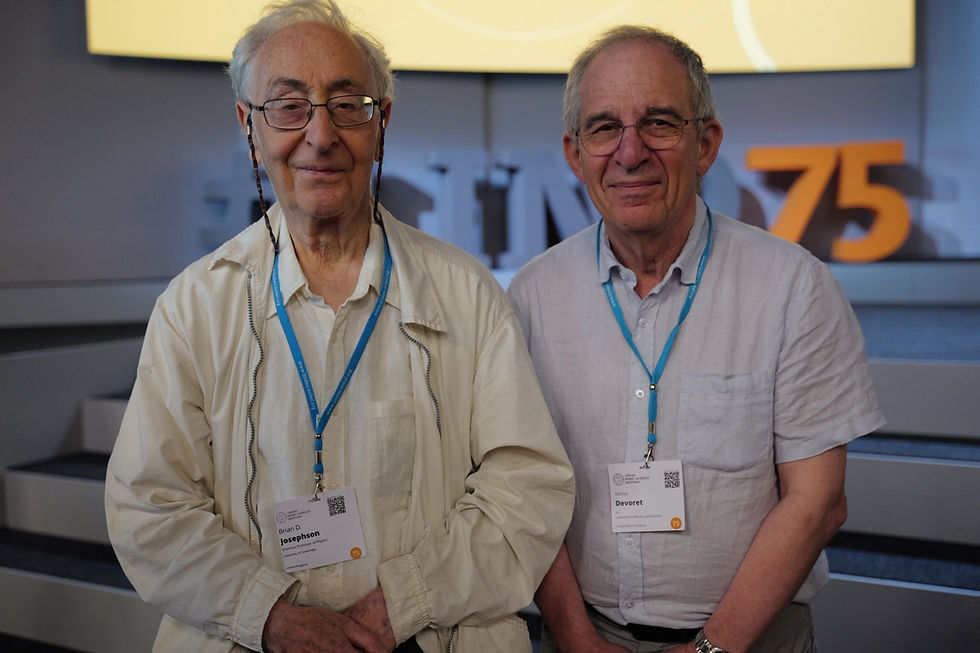
“Would you mind after this section to make a picture of Brian Josephson and myself? I have worked for 40 years on the effect he discovered in 1962.”
After the session ended, he approached Brian Josephson, and the two Nobel laureates stood together for a photograph.
For Devoret, who has spent four decades studying the Josephson effect, the moment represented far more than a commemorative picture. It reflected a scientific journey that had begun with a discovery made decades earlier.
Later, he explained why the Josephson effect occupies such a unique place in the history of physics.
“The Josephson effect is one of the rare examples, together with general relativity and the prediction of antimatter from the Dirac equation, where theory came first and experiment confirmed it afterward.”
He contrasted it with another landmark discovery.
“The quantum Hall effect, discovered by Klaus von Klitzing, followed exactly the opposite path. Nobody predicted it. It was discovered experimentally, and only afterward did the theory emerge.”
Although their histories differ, both discoveries now underpin the International System of Units (SI).
“The Josephson effect provides h/2e, while the quantum Hall effect provides h/e². Together they form part of the foundation of modern electrical metrology.”
“Choose the Mentor Before the Topic”
Devoret also offered advice for young researchers around the world.
Students often ask him what research field they should choose.
His answer is always the same.
“I tell them not to ask what they should study, but with whom they should study.”
He believes that young scientists cannot reliably predict which research topics will become important.
An apparently modest subject may later become a major field, while an exciting topic may fail because the technology is not yet ready.
“You can always change your research topic,” he said. “But the mentor and the scientific environment that shape you can influence your entire career.”
Finding the right laboratory and the right mentor, he argues, is far more important than selecting the “perfect” research subject.
Science Is Passed from One Generation to the Next
In 1976, Michel Devoret arrived in Lindau as a young scientist, listening to Nobel laureates such as Paul Dirac.
Fifty years and two months later, he returned as a Nobel laureate himself, sharing his own experiences with the next generation of researchers.
His journey reflects more than an individual scientific career. It embodies the enduring purpose of the Lindau Nobel Laureate Meetings: to bring together generations of scientists so that knowledge, curiosity, and scientific values continue to be passed from one generation to the next.