
Modern Age of Surrealism
― René Magritte

Surrealism emerged in 1924 from André Breton’s publication, “Manifesto of Surrealism,” as a creative act to reunite the conscious and unconscious realms, professed as well by Freudian psychoanalysis. Dreams and fantasies could be integrated wholly into our rational world. By transcending beyond reason and logic, the movement introduced a transformed vision of a “new reality,” also referred to as “surreality,” open to radical imagination and infinite possibilities.
Artworks are characterized by moods of reverie or ominous landscapes that transport viewers to a different dimension. For over a hundred years, the approach has penetrated all facets of life in an attempt to revolutionize people’s view of the world.
“Surrealism: Expanding from the Visual Arts to Advertising, Fashion, and Interior Design” is being shown at the Tokyo Opera City Art Gallery until June 24th. The exhibition is divided into six sections that expound on the relationships between Surrealism and objects, photography, painting, advertising, fashion, and interior design, along with their impact on daily life.
While many people perceive Surrealism as a fantasy phenomenon, its actual aim is to set aside one's subjective view and open the eyes to introspect on a more objective reality. This “hyper-reality” recognition allows us to look at a subject as an “object,” as demonstrated in the first section. Pieces by Marcel Duchamp, such as the "Hat Rack" (1917/1964), illustrate how the function of a "hanging a hat” is detached from the rack itself so that it is reduced to a simple object.
In photography, external scenes are also captured as symbolic objects. Masters such as Man Ray experimented with novel, trailblazing techniques that convert ordinary motifs into diverse enigmatic expressions. His displayed works depict “Photogram" (laying an object on photographic paper and exposing it to light without the aid of a camera) and “Solarization” (reversing the tones of black-and-white photographs). Other artists represented are Maurice Tabard, Pierre Boucher, Herbert Bayer, and Wols, who all turned subjects into ambiguous images.
Paintings involved the broadest spectrum of surrealist interpretations. The exhibition covers “automatic drawing” (freehand movement), “internal model” (going beyond the imitation of reality to link surrealism and visual art), collages, metaphysical painting (creating spaces with distorted perspectives), “decalcomania" (sandwiching paint between two sheets of paper to create accidental patterns), and other painting methods used by André Breton, Salvador Dalí, Paul Delvaux, Max Ernst, Giorgio de Chirico, Joan Miró, Oscar Dominguez, and others.
René Magritte (1890-1967) was one of the prominent Surrealists who presented familiar objects in unexpected settings. He was heavily stimulated by pop, minimalist, and conceptual art. “The Museum of the King” (1966) and “The Ready-made Bouquet” (1957) portray Magritte’s iconic man with a bowler hat, an image he had employed since the 1920s. He fused it with other hidden elements that seem to deny access to the larger image. His paintings translate into poetry and evoke mystery. In the first painting, the body of the plain and solitary man appears to have vanished, leaving only the outline and facial features. He is immersed in the vast, blue landscape around him, projecting a sense of depth and flatness at the same time. The work brilliantly reverses spatial relationships and reality. In the second work, Magritte applied the trompe-l'œil technique to add the female figure resembling Flora from “Primavera” by Botticelli over the man’s back. The marriage between reality and unreality was carefully drawn to inject a detached objectivity.

Yves Tanguy (1900-1955) was highly recognized for his bizarre and amorphous scenarios, often regarded as abstract illusionism. “The Lost Bells” (1929) suggests an almost hallucinatory perception filtered across an empty background, and subtly lifting unknown entities without purpose.
Surrealism was evident as well in the world of advertising from the 1930s. In this section, posters and illustrations reveal surrealistic techniques in collages, photomontages, and “dépaysement” (disorientation or confusion caused by a change of scenery). These were seen in fashion magazines like Vogue and Harper’s Bazaar, as exhibited.
One of the leaders of the Basel school and the hyperrealistic style, Swiss painter and illustrator Fritz Bühler (1909-1963) made his mark in effective advertising campaigns for retail products, such as cigarettes, shampoo, toothbrushes, as well as film festivals, airline companies, and a whole range of commercial media. He designed “Giodux” (1934) in stone lithography for Giodux Hats. The color composition and typography typify the modernistic trend of the era.
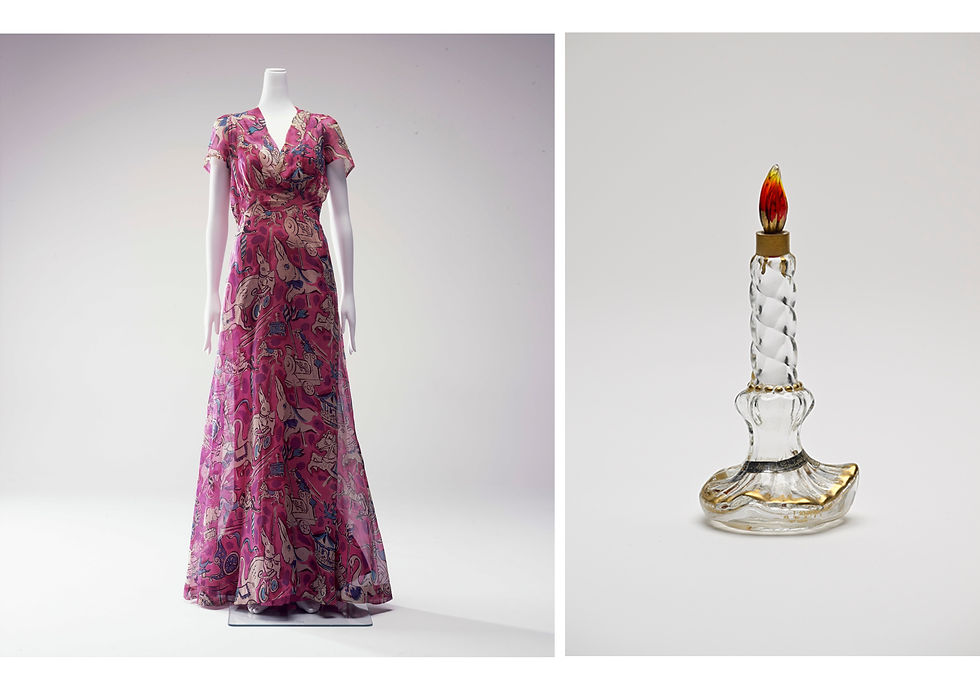
The exhibition showcases an assorted array of wardrobes and fashion accessories, particularly by world-acclaimed designer Elsa Schiaparelli (1890-1973). Schiaparelli bewildered the public with her designs of everyday motifs embedded into haute couture dresses. Surrealism in fashion turned to geometric patterns, bold motifs, and bizarre arrangements. The designer’s “Evening Dress (Circus Collection) (1938) was first shown in Paris in 1938. Circus images, like horses, elephants, rabbits, clowns, acrobats, a merry-go-round, and a locomotive train in overall pink and blue shades bring out a childlike wonder that makes the dress fun to look at. The designer’s “Perfume Bottle Sleeping” (1938), similarly mirrors a tinge of playfulness, inspired by Man Ray’s painting, “Le Beau Temps.” The contour emphasizes a candle form stylized in the harlequin’s head in Ray’s work. Schiaparelli frequently collaborated with Dalí on the design of garments and cosmetic goods.
The final chapter on interiors unveils the inconceivable transfiguration of spaces through Surrealism. The ultimate goal is to disrupt reality by triggering an unforeseen air of instability or unfamiliarity. The space itself acts as an object manipulated to reflect organic forms of nature. Such interiors appear in paintings by Chirico, Magritte, and Delvaux. The striking red “Sofa BOCCA” (1970/1972) by the Italian design team Studio 65, radiates throughout the gallery space. Also known as the “Lips Sofa” or “Marilyn,” the captivating piece epitomized Italian pop art furniture in the seventies. Its provocative, sensual, and oversized red lips were a direct derivation from Dalí’s 1935 painting, “Mae West's Face Which May Be Used as a Surrealist Apartment.”

On view is Eugène Atget’s (1857-1927) “Worker’s Bedroom, rue de Belleville” (1910), which interprets the cramped living conditions of the working class. Packed with furniture and randomly cluttered items, the room zooms in on each of them minus the existence of the occupant. A breath of stillness and eeriness drifts, allowing the objects to speak for themselves.
The exhibition is a wonderful exposition of the powerful and profound ideas of legendary Surrealists, which continue to infiltrate contemporary art and lifestyles.
Gallery view, Fashion: Arousing Desire, “Surrealism: Expanding from the Visual Arts to Advertising,
Left: Gallery view, Fashion: Arousing Desire, “Surrealism: Expanding from the Visual Arts to Advertising, Fashion, and Interior Design,” Tokyo Opera City Art Gallery, Photo © Alma Reyes
Right:Gallery view, Interiors: Transforming Interior Spaces, “Surrealism: Expanding from the Visual Arts to Advertising, Fashion, and Interior Design,” Tokyo Opera City Art Gallery, Photo © Alma Reyes
Details
“Surrealism: Expanding from the Visual Arts to Advertising, Fashion, and Interior Design”
Tokyo Opera City Art Gallery
Until June 24, 2026
Closed Mondays ((except Monday, May 4 and Thursday, May 7)
11:00-19:00
Some works will be rotated during the exhibition period.
Written by Alma Reyes


